Qatar’s road network relies heavily on cameras and regular police checks. As a visitor, you can enjoy the freedom to drive in Qatar on wide roads, but only if you understand the documents you must carry and how local traffic behaves.
If you are a tourist, navigating Qatari roads can feel easy one moment and stressful the next. Doha has big roads and many roundabouts. Outside the city, you may encounter hazards such as poor lighting and even wandering camels.
So before you rent a car in Qatar, set yourself up for safety. Our guide helps you gain confidence so you can explore beyond the metro and taxis.
Driving in Qatar is mainly about your driving documents, your visa status, and the time you have been in the country. The acceptance of a foreign licence depends on where it was issued and how long you stay. Because penalties can be severe, you should treat document checks as part of your normal driving routine, not as a rare event.
First, check the legal driving age. In Qatar, the minimum driving age is 18.
Next, think about your foreign licence. Rules can vary by nationality and visa type, so you should use official travel advice as your baseline. For example, U.S. licence holders can drive in Qatar for two weeks, while Canadian licence holders can drive for up to seven days.
Some visitors with widely recognised licences (often from higher-income countries) may be granted longer stays under a tourist visa. Most first-world home-country licences are valid for the duration of a tourist visa, while other licences (and people on a permanent visa) may only be valid for 7 days from entry.
Finally, match your driving document to your visa. An international driver’s licence can be valid for up to six months with an official visit visa from the date you enter Qatar when used together with a valid “first world” licence. International driving licences are valid in Qatar for 6 months from the date of arrival, and residents should apply for a full Qatari licence.
An International Driving Permit (often called an IDP) is not “a new licence”; it is a translation of your home licence that helps local authorities read your details correctly while on the road. You normally need to carry it together with your original home licence, because it does not replace your domestic licence.
Qatar requires visitors to have a valid IDP to rent a car and legally drive. For anyone planning a road trip in Qatar, authorities advise visitors to get the IDP in their home country or country of residence before travelling.
Even if your IDP itself may be issued with a longer validity, multiple official travel sources note “up to six months” as the practical window for using an international driving permit/licence in Qatar for certain visitors or new residents.
Car rental agencies often require an international driver’s licence/permit even when a country may accept a foreign licence for limited driving. This is especially common for tourists renting vehicles locally, as rental providers must ensure legal compliance.
Get it before you fly. You should apply in the same country that issued your national licence, often via an authorised automobile club or motoring organisation. If you drive without the right papers, the penalties can be serious. Penalties can be severe for operating without a valid licence. If an IDP is required and you cannot produce one, you may face fines or citations, and authorities may even seize the vehicle or arrest you.
If your home licence is only valid for a short time, you may need a quick temporary solution. For “any other” driving licences (and for people with a permanent visa), the licence may be valid for only seven days from the date of entry, and you should obtain a temporary driver’s licence before those seven days end.
A temporary Qatari licence may involve a vision test and a fee. A temporary Qatari licence is being issued after a vision exam and a fee of QAR 150.
If you become a resident, the expectation changes. New residents may use an international driving permit for up to 6 months, during which they can convert it into a valid Qatari driving licence. Resident expatriates should apply for a full Qatari licence.
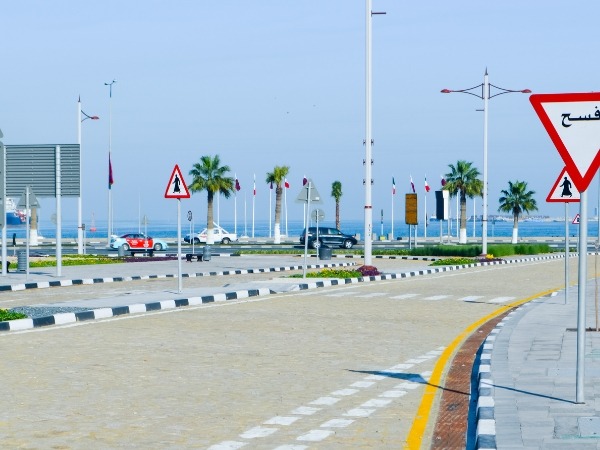
The risk of driving locally is shaped by road design, traffic density, and conditions outside the city centre. Many roads support higher speeds, and the traffic system uses many roundabouts and ongoing construction projects. Dust storms or winter rain can also reduce visibility and even make some roads impassable.
Qatar’s traffic system works like a right-hand traffic country, where the right lane is often the slower or merging lane, and the left lane is treated as a fast lane. In simple terms, you keep right, and you overtake on the left, and you will notice many drivers using the left lane much of the time.
Many drivers prefer the left lane on two-lane roads, and on three-lane roads, many use the middle or left lane, leaving the right lane for slower vehicles and for entering traffic.
In Doha, you will mostly drive on wide, multi-lane roads, but you should expect busy junctions, sudden lane changes, and traffic built up around roundabouts. Outside the city, the same official guidance that warns about roundabouts also warns about rural hazards, such as poor lighting and roads without shoulders.
Also, plan for construction. Numerous road construction projects are one of the reasons why driving can be challenging. Treat every work zone as a place where lanes can shift, and drivers may make sudden moves.
Roundabouts are everywhere, so roundabouts are not a “special case” here. Outside the city, be alert for camels and other animals near the road. When exploring rural areas, watch out for wandering camels in rural areas. Dust storms can reduce visibility and disrupt road traffic, and the rainy season from December to January can bring seasonal flooding. This makes roads impassable and damages bridges.
Traffic flow here often feels faster and more direct than in many Western countries, especially on multi-lane roads and at roundabouts. To drive well, you need both strong observation skills and the ability to make clear, early decisions.
A good mindset is “defensive but ready.” You should expect the unexpected and even “anticipate the worst” from vehicles around you. This does not mean driving aggressively. It means you scan more, you leave extra space, and you avoid trusting other drivers’ indicators.
In Qatar, flashing headlights often means the car behind you wants you to move out of its way. If a vehicle approaches quickly with flashing headlights, the driver is in a hurry and wants you out of their path; the safe response is to signal and move over when it is safe to do so. It also warns you not to “brake-check” by tapping your brakes to show your brake lights, because the other driver may see that as an aggressive act.
A car horn in Qatar is often just a “signal of presence,” not a sign of personal anger. Horn usually means “I’m here,” and you may hear an enthusiastic burst of honking when the lights turn green or when someone behind thinks you could have moved sooner.
While behind the wheel, you should not lose your temper, use foul language, make hand gestures, or exhibit aggressive behaviour. Incidents involving obscene language, gestures, or insulting comments can result in arrest, imprisonment, and/or fines. They can also lead to arrest and overnight detention.
In Qatar, lanes are not always used the way you expect, so you must read the road and the cars more than you read “rules on paper.”
Start with the basic lanes idea: many drivers prefer the left lane. On three-lane roads, many people drive in the middle or left lane (leaving the right lane for slower vehicles and entering traffic), and on two-lane roads, many people drive in the left lane.
On single-lane roads, the same guide gives a simple warning: be careful. This is where overtakes, sudden stops, and unplanned turns can feel more dangerous because you have fewer escape options.
Roundabouts are a core part of Qatar's driving rules, so treat every roundabout like a high-risk merge. On a two-lane approach, the right lane is for turning right, and the left lane is for going straight, turning left, or turning around (unless signs say otherwise). From a three-lane approach, the right lane is for turning right, the middle lane for going straight, and the left lane for turning left or backing.
Using your signal at the right moment is important. In a roundabout, you should turn on your indicator as you near your exit so other drivers can anticipate where you’re going.
Right of way is just as important for safe driving practices. Vehicles already circulating in the roundabout have priority. Most drivers follow this rule, so you should wait for a safe opening before entering.
Traffic enforcement in Qatar is technology-led, using mobile radar and fixed cameras, plus spot checks by traffic police. Many offences can be recorded without police, and the first time you hear about a ticket might be later. Unpaid fines can create travel problems, so treat following local traffic rules as part of your ''legal compliance''.
Wearing a seat belt is mandatory. Traffic police may conduct random inspections, including checks for seat belt use; failing to wear one can result in a fine of QAR 100.
Qatar speed limits apply to all roads and are strictly enforced. Monitoring may involve mobile radar cameras and unmarked vehicles equipped with video cameras. Speeding fines can range from QAR 300 to QAR 500, depending on the violation.
Running a red light is taken very seriously. Many intersections are equipped with fixed cameras that can capture images of vehicles that run red lights, and the penalty can be as high as QAR 1200.
Driving at excessively high speeds can lead to more severe consequences. In serious cases, authorities may impound the vehicle. Alcohol and driving are strictly prohibited.
One challenge with camera enforcement is that a violation might not come to your attention right away. You could receive a traffic penalty without realizing it and only discover it later, such as when renewing your vehicle registration, after being involved in an accident, or even when leaving the country.
Traffic fines can be costly; many offences are detected by cameras, and unpaid fines may lead to an exit ban until the amount is settled. Traffic violations are specifically mentioned as a possible reason for such bans, so be responsible when navigating the country.
Driving in Qatar is manageable when you prepare your paperwork, keep your documents together (home licence plus IDP if needed), and keep copies of key pages in a safe place. Once you are on the road, stay patient, drive defensively, and assume cameras are watching key junctions and speed zones.
Rent a car in Qatar with Final Rentals if you’re ready to hit the road. Select Hamad International Airport, Salwa Road, or Haloul Street as your pickup location, enter your travel dates, and choose a vehicle for your trip. Book and manage your car rental at any time. Download the Final Rentals app on Google Play and the App Store.
Yes, but the time limit depends on your documents. For example, U.S. licence holders can drive for two weeks, and Canadian licence holders can drive for up to seven days, after which they may need an international driving permit.
Often, yes, especially for car hire. Many rental companies require an IDP/international driver’s licence, and some visitors must carry one to drive legally.
Speed enforcement can include mobile radar and video-equipped vehicles, as well as fixed cameras at signals and on roads. Unpaid fines can lead to an exit ban, so treat every speed sign and red light as “camera-enforced.”